Baguio Arboretum
The Baguio Arboretum is a five-hectare forest landscape within the Forbes Park Forest Reservation Parcel No. 2 along Leonard Wood Road. Development began in 2018–2019 through the DBM Local Government Support Fund under the Green, Green, Green Program. The City Government of Baguio continued the project through locally funded multi-year allocations to advance and complete its long-term vision. The park closed during the COVID-19 pandemic and has been under renovation for the past six years. In 2026, the Baguio Arboretum is set to reopen with a newly refurbished Boardwalk and a new spot called the Baguio Arboretum Gallery.
The Baguio City Government approached Haring Ibon - Birds in Focus, Inc. to consult on the new development, particularly the Baguio Arboretum Gallery, to showcase the Birds of Baguio City and the Cordilleras for tourists and parkgoers alike.
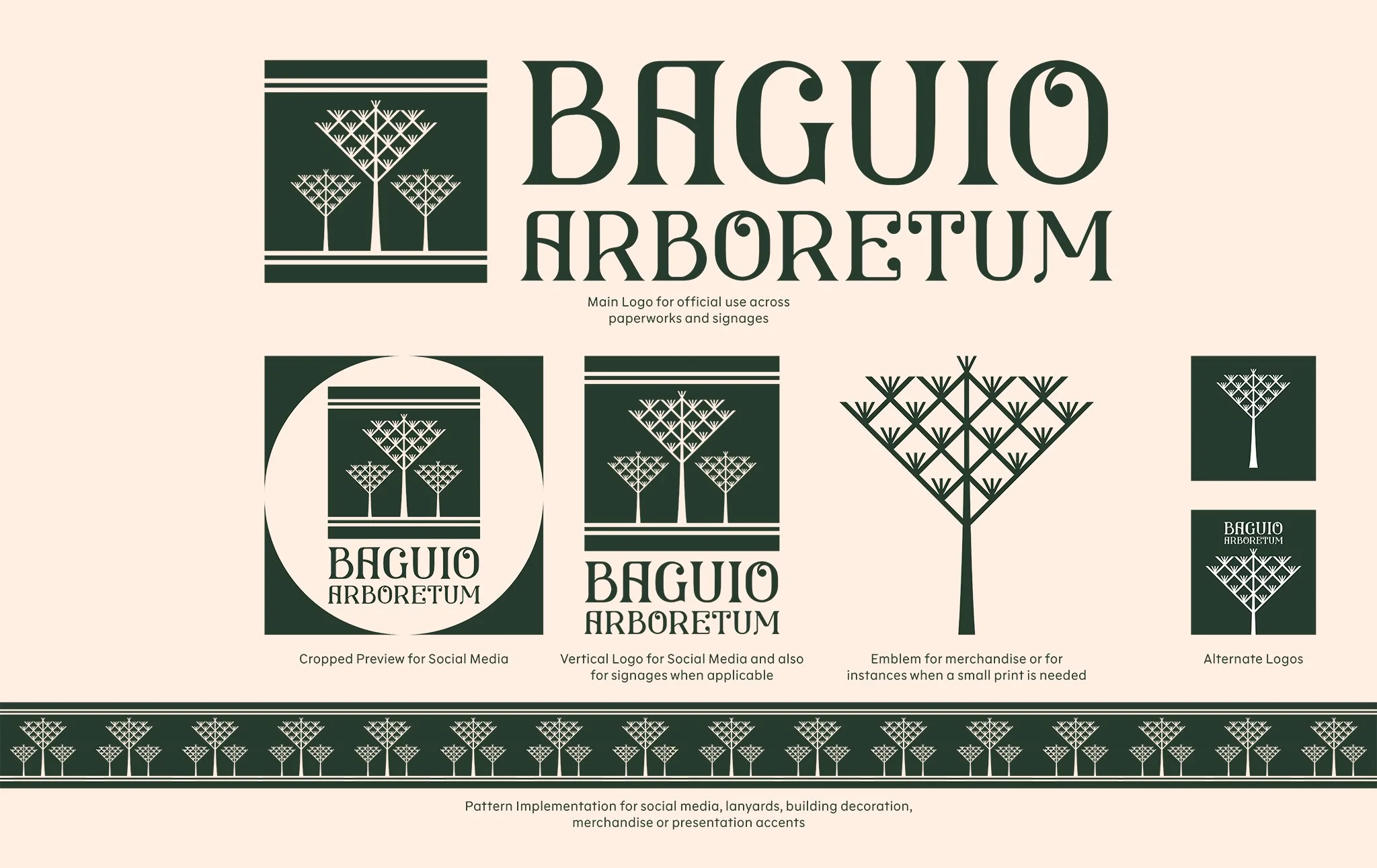
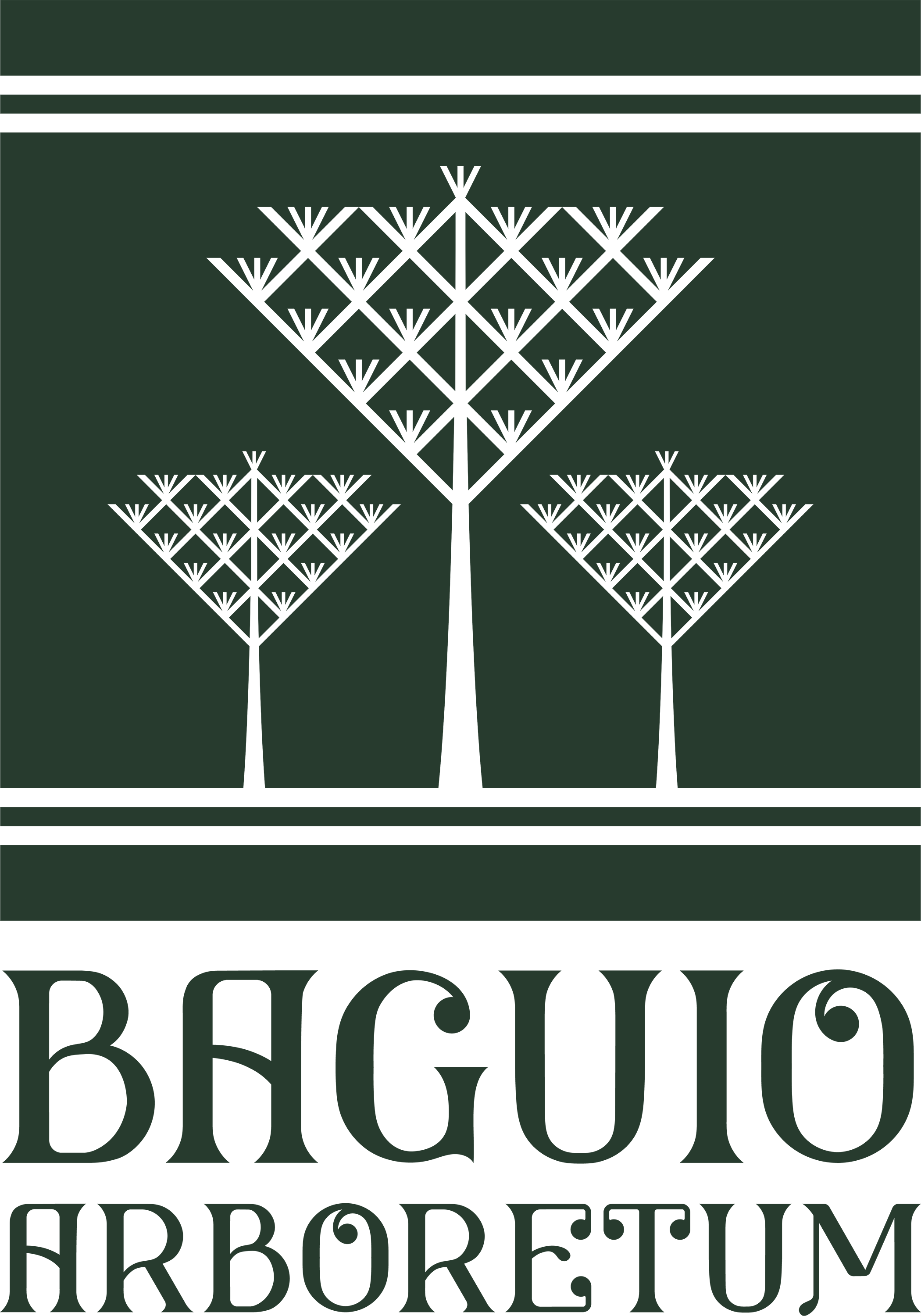
As the Baguio Arboretum developed, the Baguio City Government tapped me to design the Arboretum's logo to represent the new park, featuring its most famous tree species, the Benguet Pine, as well as aspects of Cordillera culture.
As a place of immense natural and cultural heritage, creating a logo that respects its background, past, environment, and future is such a monumental task, and a lot of research, not only on the Benguet Pine but also on Cordillera culture, became essential when approaching a logo for a place like Baguio City.
By the end of my research phase, I narrowed down the essential elements to include in the Baguio Arboretum Logo: the Benguet Pine, Cordillera textiles, and Cordillera tattoos. The Benguet Pine is the most abundant species in the Arboretum and in the greater Benguet and Cordillera areas. Its inclusion is an obvious one. However, very few modern Filipino designers use our tattoo or textile heritage as a starting point for their design process. Since the precolonial era, tattoos and textiles, especially across the Cordilleras, have been among the earliest visual expressions of Philippine art. Their principles, particularly designing with lines to convey big shapes and parallelism, must be an important precedent when it comes to designing a logo within the context of Baguio, especially amidst the disgusting trend of AI logos and pushy modernist logos that don't respect the background they are in, particularly a lack of designing Filipino.
Initial Logo Development
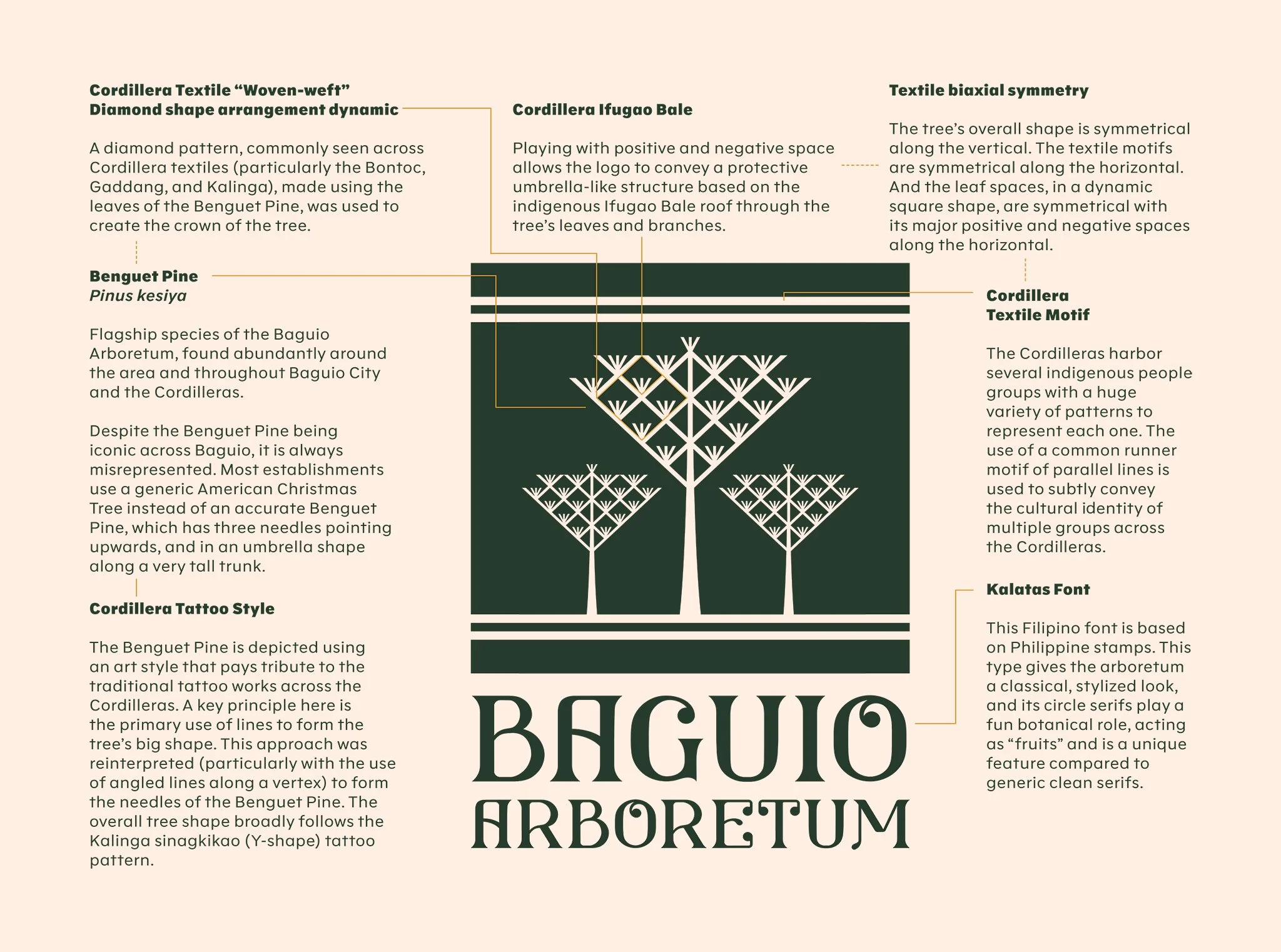
Designing a logo for the Baguio Arboretum was always going to center on the Benguet Pine (Pinus kesiya), the most abundant tree species in Baguio City and across most of the Cordillera Administrative Region. This initial surface-level background begs an initial question: why hasn’t there been a logo that faithfully depicts a Benguet Pine? The new Baguio Arboretum will attempt to challenge that by using several Cordillera precedents to faithfully and artistically depict the region’s most iconic tree, making the Arboretum a go-to destination for nature-lovers.
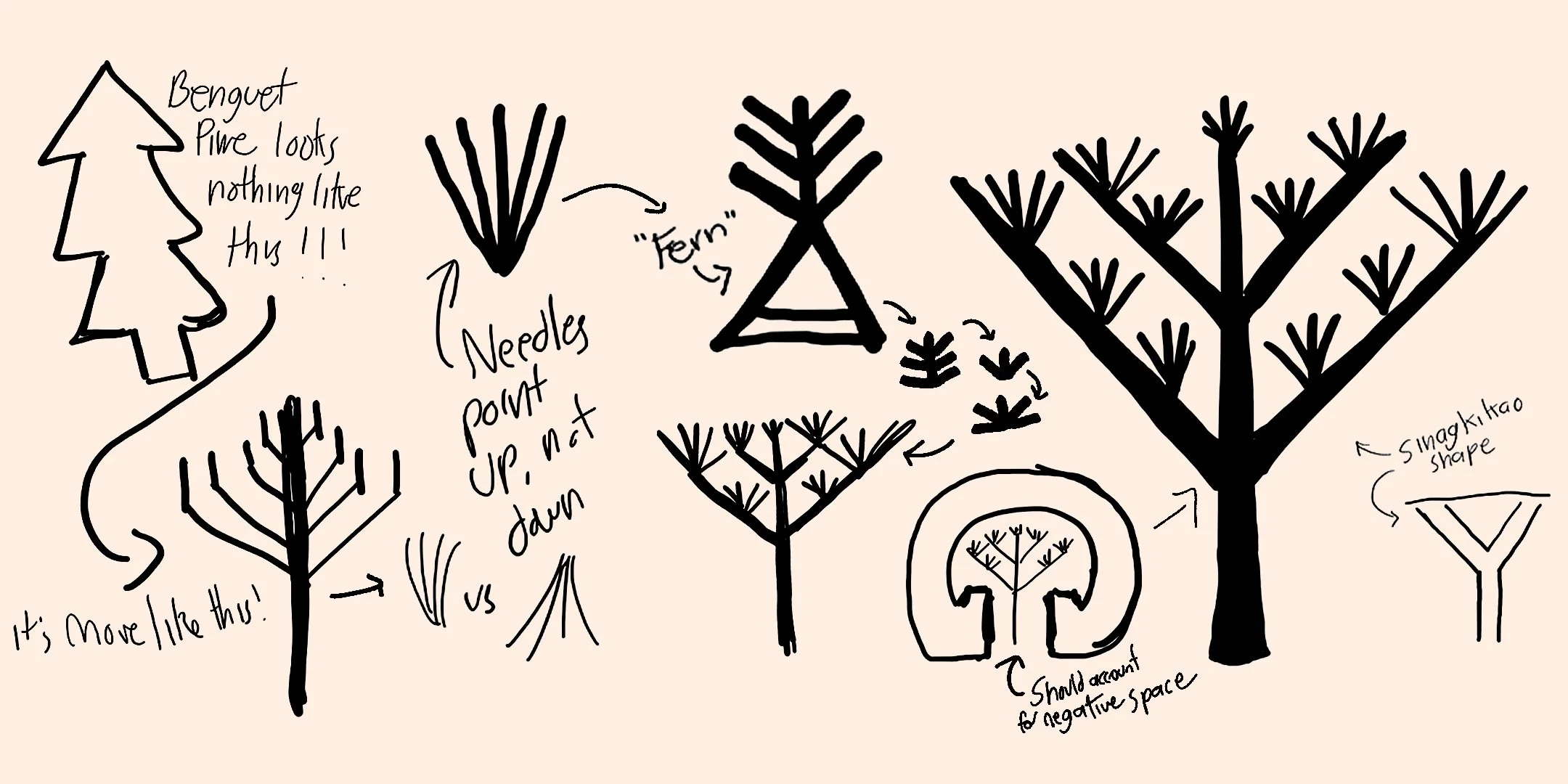
The first part involved rejecting the norm, the stereotypical American Christmas Pine tree triangle shape, which is, unfortunately, the norm across most Baguio-centric designs in cafes and small shops. Realizing that the American Christmas Pine usually relies on shapes to dictate the logo design language, our approach rejects that by following lines to form shapes instead of shapes as its main graphical tool. Why? Because Cordillera Indigenous groups have always used lines in their tattoo practices, which are among the earliest instances of Philippine Visual art across the archipelago. We felt that the use of line-like shape work is made even more appropriate since, if you look at a Benguet Pine up close, its leaves are not a typical broadleaf shape; they are needles, which makes it a perfect shape to depict in a line. This plant precedent is also built up on indigenous knowledge because of common Fern motifs found in Cordillera Tattoos, particularly those in the Kalinga indigenous group.
This first logo of the Baguio Arboretum incorporates elements of Cordillera tattoos while remaining faithful to the actual Benguet Pine tree shape in its own stylized line-art take. This logo broadly follows the sinagkikao (Y-shape) tattoo pattern to build the tree’s trunk and form the rest of its wide crown, while following a symmetrical shape dynamic for its needles using lines angled along a vertex.
Second Iteration
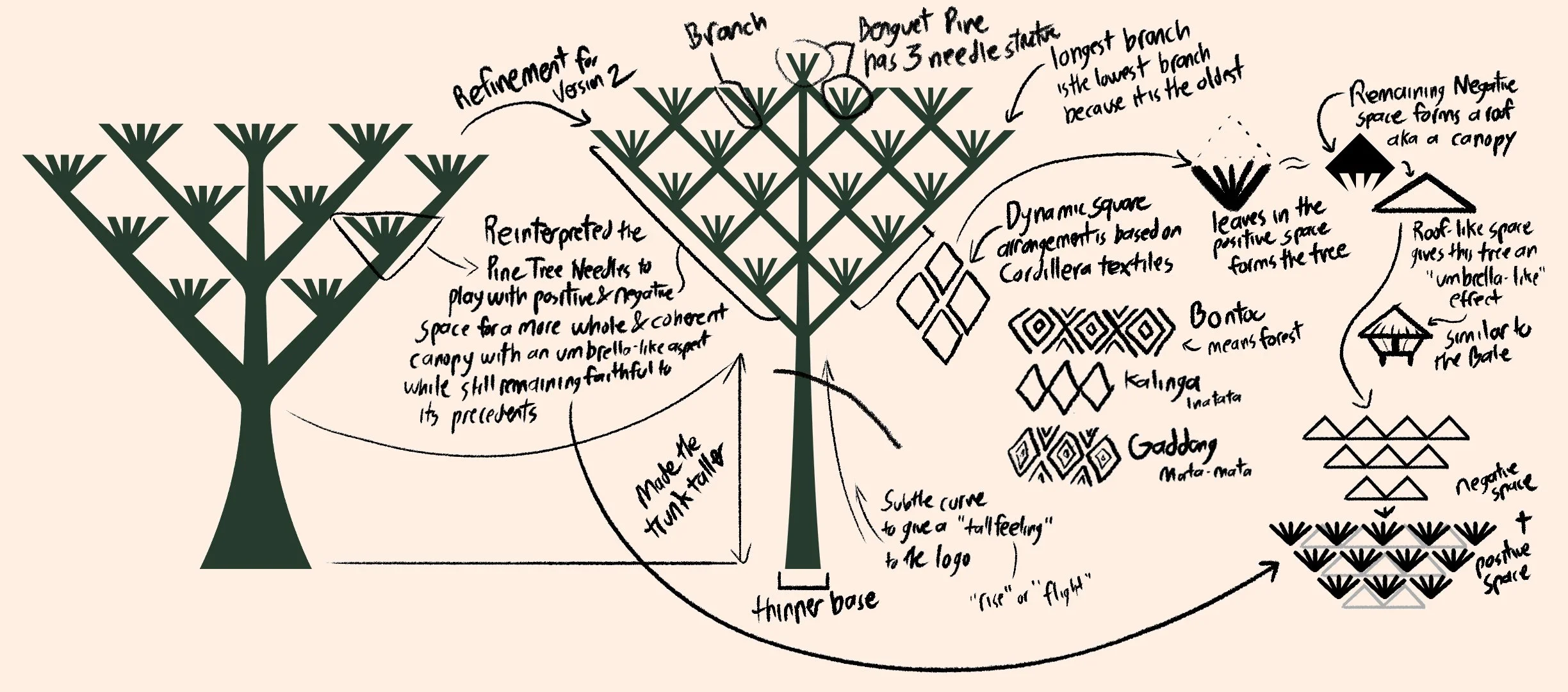
Following the initial comments given to the first logo to make the tree taller, thinner, and more like an umbrella-like structure, this new logo iterates on the first while still utilizing its existing elements and refining it to fit these new concepts. Additional concepts to keep this new approach rooted in Cordillera traditions, such as following biaxial symmetry (not just in making the logo symmetrical, but also in playing with positive and negative spaces), Cordillera textiles, and even indigenous architecture, help dictate the process of making this new logo. Making the tree taller and thinner was simple enough, but incorporating an umbrella-like structure pushed us to think about the logo in both positive and negative space to incorporate that feeling, while still using the sinagkikao shape (Y-shape) common across natural Benguet pines. This was achieved by following the woven-weft diamond structures of Cordillera textiles (which resulted in a Diamond-like look as dynamic squares) and combining it with the roof-like structure of the Bale (Ifugao House) to create a canopy-like umbrella shape in the negative space of the new logo emblem.
Third Iteration
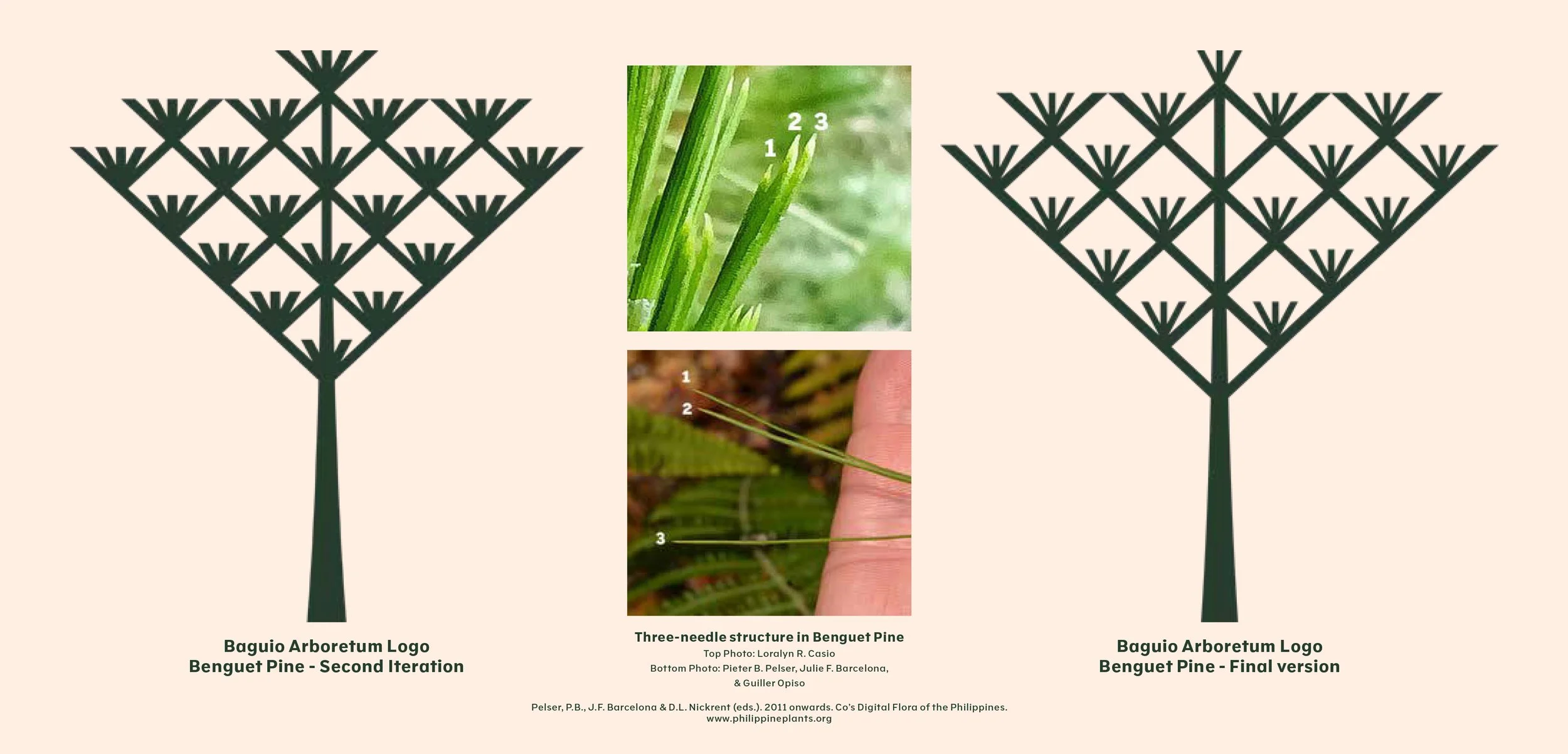
Following our second iteration of the Baguio Arboretum logo, we made a minor change to reflect better the look of a Benguet Pine (Pinus kesiya) in our current understanding. This change was suggested by Sir Anthony Arbias, the current president of Philippine Native Plants Conservation Society Inc., to clearly show the three-needle leaf structure of the Benguet Pine in the logo, making it a feature guests can explore up close when they visit the Arboretum and see a Benguet Pine, especially during guided tours where an instructor or a guide can show the three-needle feature up close.
According to Sir Anthony Arbias’ field experience, the Benguet Pine has 3 needles; this is the unique characteristic of the Benguet Pine, whereas the Mindoro Pine has only 2 needles, and other foreign pine species have 4 needles.
Previously, the second iteration of the logo had what looks like five needles on the tree. Still, this updated logo for the third iteration now distinguishes between the “leaves” and the “branches” by varying the line thickness to demarcate a leaf-needle and a branch, with the leaves much thinner and more prominently clustered as a group of three lines.